The Beat Between Lines: Why Stage Pauses Need Room
Stage pauses shape tension, thought and listening. Learn a simple way to mark silence while reading a scene aloud without making every beat feel alike.
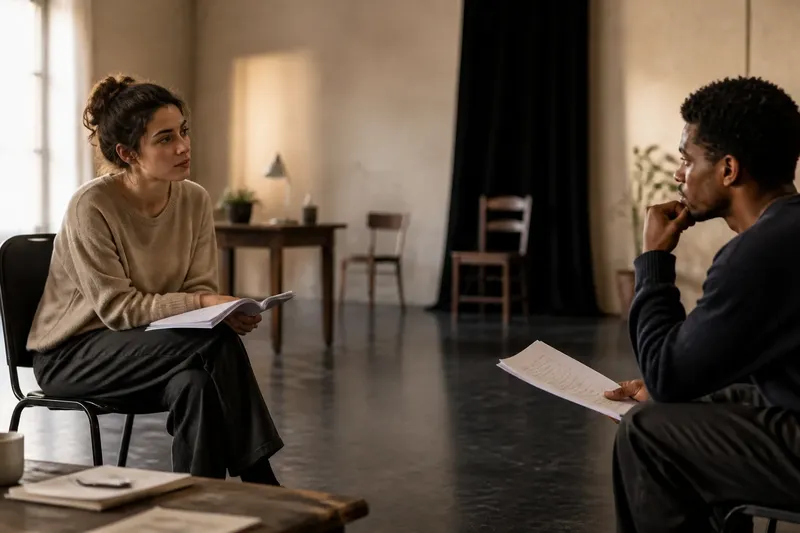
How long should an actor wait before answering? In a scene read aloud, a stage pause can make a reply feel considered, defensive or unexpectedly tender. The useful length is not a fixed count: it is the time the moment needs to change what the audience understands.
Try these seven ways to hear what a silence is doing, then mark only the pauses that have a reason to be there. The aim is not to make a script look dramatic. It is to give actors and listeners room to notice the exchange.
1. Let the thought finish before the mouth begins
A pause often belongs to the character’s thinking, not to the punctuation. A comma can carry a quick adjustment; a full stop may still lead straight into the next line if the speaker has already decided what to say. Conversely, a character can stop in the middle of a sentence because a new thought has arrived.
When you read a scene aloud, listen for the instant a character changes direction. Perhaps they begin with a reproach, then soften it. A small gap before the gentler phrase lets the shift register without turning it into a speech.
Say you are reading a fictional scene in which Mara asks Jo, “You kept the letter?” Jo says, “I kept the envelope.” If Jo pauses before “envelope”, the answer may sound like a careful correction. If the pause comes after it, Jo may be waiting to see whether Mara will press further. The words stay put; the listener’s attention moves.
Mark the pause where the thought turns, not wherever the sentence happens to have a comma.
2. Give a silence a playable reason
A note such as “pause” tells an actor to stop speaking, but it does not say what the character is doing. On a first reading, try a brief cue beside the line: “recognises”, “withholds”, “listens”, or “decides”. These verbs point towards an action that can be played and heard.
Keep the cue light. It is a prompt for exploration, not a verdict about the character’s inner life. If “withholds” makes the exchange stiff, try “chooses” or remove the note and read the scene again. A useful pause gives the actor a task without prescribing a facial expression or a precise emotional result.
Take one line at a time. Ask what changes during the quiet, even if the change is as small as choosing not to answer the question that was asked.
3. Separate a pause for listening from a pause for suspense
Silence can direct attention in different ways. A listening pause allows a character to receive something: a distant sound, an unfinished thought, or a companion’s reply. A suspenseful pause holds back information the audience wants. They may last about the same time in rehearsal, yet their shape is different.
In a listening beat, the actor’s focus has somewhere to go. The audience can watch the character take in what has been said. In suspense, attention gathers around what has not yet been revealed. If every silence is played as a dramatic hold, the audience has no quieter kind of attention left to recognise.
Read the line before the pause with the next action in mind. Is the character receiving, refusing, or waiting to make a move? That choice helps the silence land as part of the exchange rather than a gap between speeches.
4. Mark duration only after you know the action
For a simple scene-reading method, use a pencil and a small set of marks. A single slash can mean a short beat; a double slash can suggest a fuller silence. Beside either one, add a verb if the action is unclear. These marks are private working notes, not a code every actor must follow.
Read the scene once without adding anything. On the next pass, mark only the places where a listener needs time to register a change, or where a character’s response depends on what they hear. Then read it again at a natural speaking pace. If a marked pause interrupts the thought rather than sharpening it, shorten it or erase it.
Imagine that two fictional neighbours are negotiating who will keep a shared key. During one read-through, you mark a double slash after “You can have it back”. Reading aloud, you notice the reply already comes from the same impulse as the offer. The longer silence makes the exchange feel arranged, so you replace it with a single slash and the conversation keeps its unsettled edge.
Begin with the action; use the mark to remind yourself, not to dictate a clock.
5. Keep punctuation and pause marks distinct
Punctuation helps a reader follow grammar, but it does not prescribe stage timing on its own. A dash may interrupt a thought, introduce a correction or mark an abrupt change of direction. An ellipsis can suggest a voice trailing off, yet it can also become a habit that makes every line sound hesitant.
During a read-aloud, do not automatically turn each full stop into a wait. Some replies connect closely to the line before them; others need space despite having no special punctuation. Treat the text as a map of the sentence, then listen for the relationship between speakers.
If the script already contains a pause direction, keep it visible and consider what it asks for. Add your own notation only where it clarifies a playable choice. That leaves the page legible and makes it easier to revise a timing idea later.
6. Notice what the audience can hear in the quiet
A pause does not mean that nothing is happening. The audience may hear a chair shift, a breath, a distant door, or the change in a room after a line has been spoken. Those details can make silence feel inhabited rather than empty. They should support the scene’s attention, not decorate every gap.
In a quiet room, a small breath can carry clearly. In a larger or noisier space, the same detail may disappear, and an actor’s stillness or focus may communicate more. During a reading, you can listen for whether a pause remains intelligible when the voices stop. If it feels blank, ask whether the character has an action in it, or whether the gap is simply longer than the thought requires.
Do not fill every silence with a sound. Sometimes the audience needs to hear the absence of a reply.
7. Let the next speaker alter the length
Timing belongs to the exchange, not only to the person who is silent. The next speaker may interrupt, wait for permission, or answer before the previous line has fully settled. A pause that seems convincing when read alone can feel untrue once another actor responds to it.
For a read-aloud pass, ask the person taking the next line to listen rather than count. Their entrance can show whether the silence is still active: they may speak as soon as they understand, or hold back because the other character is not finished. If the pause is meant to be shared, both readers need to leave room for that uncertainty.
Compare the scene with the next line spoken immediately and with a brief, attentive wait. Choose the version that makes the relationship clearer, not the one that sounds most solemn.
What should you listen for when marking a stage pause?
Should every full stop have a pause?
No. A full stop closes a grammatical unit, but the dramatic thought may continue straight into the next line. Add a pause only when the character’s attention, intention or response changes enough to need room.
How can you tell a pause is too long?
Listen for whether the silence still contains an action the audience can follow. If the thought has already landed and no new choice or response is developing, shorten the gap and read the exchange again.
What does a slash mean in a script?
For a private read-aloud, a single slash can remind you of a short beat and a double slash of a longer one. These are informal working marks, so explain them to anyone sharing the page and adapt them to the scene.
Can silence be active without dialogue?
Yes. A character can listen, decide, avoid answering or watch another person react. Give the silence a clear action and the audience has something to attend to, even while no one speaks.
A pause earns its place by changing the exchange
Read the scene once without notes, mark only the moments where attention shifts, and speak it again with your scene partner. Keep the stage pauses that reveal a thought, alter a response or make listening visible; remove the ones that merely slow the page. That small editing choice leaves the actors free to discover the timing in the room.