A First Visit to an In-the-Round Performance
An in-the-round performance feels different from every seat. Choose a view that suits you, arrive ready to read the room and follow the action around you.
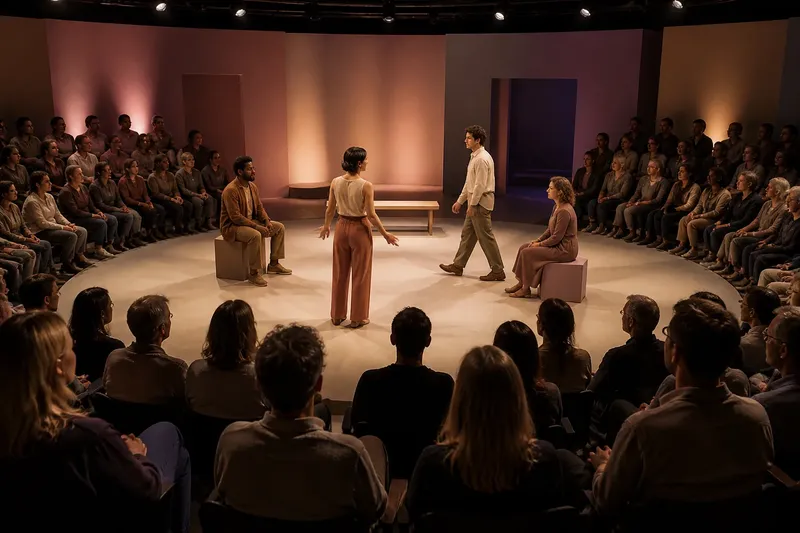
Where should you sit for an in-the-round performance, and how do you follow a scene when the actors face audiences on every side? Your first visit is easier if you choose a seat for the kind of view you enjoy, then give yourself a little time to notice how the room works before the performance begins.
In-the-round theatre places the playing area in the centre, with audience seats arranged around it. There is no single front. An actor may speak towards one section, turn to another, or cross the space while the scene continues. That shifting relationship is part of the form: you see other audience members as well as the action, and a moment can look different from one side to the next.
For a first visit, think in terms of three approaches: choose a balanced view, choose a close view, or choose a seat based on comfort and access. Each offers something different. The best choice is not necessarily the one closest to the actors; it is the one that lets you stay attentive without worrying about what you might miss.
In-the-round seating rewards a balanced view
If you want to understand the overall shape of a scene, look for a seat that gives you a clear view across the playing space. A position near the middle of one audience bank often offers a useful balance: you can see entrances, crossings and the changing arrangement of actors without turning your head constantly.
From a balanced seat, it is easier to notice how performers create a shared focus. A person standing at the edge of the playing area may draw attention through stillness, while another actor’s movement carries the eye across the centre. You can also see the scene’s shifting pictures: who is grouped together, who has space around them, and who is left looking towards someone they cannot quite reach.
The trade-off is that you may be a little farther from small details. A quiet expression or a prop held close to the body can be harder to pick out than from the front row. If you value the whole composition more than facial detail, a balanced view is a sensible first choice.
Check the venue’s seating plan and any view notes before booking. A seat described as restricted may have a particular obstruction, while a side position can offer a deliberate angle rather than a poor view. The theatre’s box office can explain what a plan alone does not make clear.
A close seat makes movement feel immediate
Sitting near the playing area can make a performance feel unusually direct. You may notice an actor’s breath before a line, the way a hand changes direction, or the moment a performer shifts attention from one audience bank to another. That proximity can be absorbing, especially in a small room where the performers’ physical choices carry much of the storytelling.
Close seats also ask more of your attention. Actors may move between audience sections, and a scene’s main focus can travel away from you. You might see the back of a performer for part of a conversation or catch a facial expression that other spectators cannot see. Those are not necessarily missed moments; they are one angle on a performance designed to be shared among several sides.
Consider how you like to watch. If you enjoy reading faces and feeling near the action, try a close seat, perhaps slightly back from the very front if you prefer a broader view. If you find yourself straining to look from one side to another, or feel distracted by being conspicuous, choose a position farther away.
For some productions, the playing space reaches close to the first row or includes pathways through the audience. Check the event information for any seating or participation notes, and ask the venue if you are unsure what the arrangement means for your visit.
Comfort and access can be the best starting point
A seat that looks ideal on a plan is not useful if getting to it or remaining there makes the performance difficult to enjoy. Think about the practical conditions that matter to you: step-free access, space for a mobility aid, an aisle position, the distance to an exit, or the ability to leave and return without crossing the playing area.
Contact the venue’s access team or box office before booking if you need a particular arrangement. They can clarify the route into the room, where accessible seats are located, and whether a companion seat or other provision is available. If you use hearing assistance or need a different way to receive performance information, ask what the venue offers for that specific production.
Comfort is not a lesser concern than a good sightline. A seat that lets you settle, hear clearly and remain present can be a better choice than the nearest available place. If you are attending with someone else, compare the needs of both visitors rather than assuming you must sit in the same kind of position.
Arriving early helps you read the room
Try to arrive with enough time to find your seat without rushing and to look around before the performance begins. The room itself can tell you what to watch for. Notice the entrances, the edges of the playing area, any changes in floor level, and whether audience members are seated at different heights. You do not need to memorise the layout; a few quiet observations help you feel oriented.
Look at how the performers use the space as they enter or settle, if they are visible before the start. Some productions begin with activity already under way, while others keep the playing area empty until the performance. Follow the theatre’s guidance about photography, phones, late seating and when to take your place, especially where the audience surrounds the action.
Imagine you have chosen a seat near the centre of one bank and arrived before the room fills. You notice a narrow entrance opposite you and a clear path between two audience sections. Once the performance begins, an actor crosses that path while speaking to a character seated on the other side. Because you spotted the route beforehand, you can follow the crossing without searching the room or wondering whether a spectator is being asked to move.
Keep belongings tucked away and avoid stretching into the playing area. In a close arrangement, a coat sleeve or bag can affect someone else’s view as much as it would in any theatre, and the boundary between audience and action may be less obvious.
Watch how attention travels around the space
In an in-the-round performance, actors cannot rely on facing one direction throughout a scene. They adjust their bodies and voices so that different sections can share the action. A performer may open a stance towards one side, then turn as a new speaker takes focus. Another may stand at an angle, making the exchange visible to two groups at once.
Rather than trying to see every face at every moment, follow the cues that organise attention. Notice who is speaking, who is listening, and where a pause or movement shifts the focus. If an actor crosses behind another, watch how the group changes shape. The audience’s gaze often travels with a clear gesture, a change of position or a sudden stillness.
Actors may sometimes have their backs to you. A turned back can make a scene feel private, or it may simply be the natural result of addressing someone across the space. Listen for the line and watch the relationship between performers rather than waiting for every face to turn your way. A reaction from across the circle can be just as revealing as the speaker’s expression.
Other audience members are part of what you see, but they are not a second performance to decode. Let your attention rest on the actors and the changes in the room. If a laugh or a gasp travels around the circle, notice it briefly and return to the scene.
Which approach fits your first visit?
Is the middle of an audience bank the best first seat?
It is a helpful choice if you want to see the overall arrangement and follow movement without sitting very close. It may not provide the clearest view of small facial details, so check the venue’s seating notes if that matters to you.
Should I choose the front row for a more vivid experience?
Choose it if you enjoy closeness and are comfortable with performers passing nearby or turning away from you. If you prefer to see the full playing area at once, a seat farther back may feel easier to watch.
Can I tell which side has the best view?
There may be no single best side, because actors can direct attention around the room and the arrangement may shift between scenes. Look for a seat with a clear sightline to the centre, and ask the box office about any known obstructions or production-specific seating notes.
What if I need an accessible or less exposed seat?
Tell the venue what would help, such as step-free entry, an aisle position or a little distance from the playing area. The access team or box office can discuss available options for the particular room and performance.
Choose by what you want to notice
For a first in-the-round performance, make the decision in this order: identify any access or comfort needs, decide whether you value closeness or a broader view, then check the venue’s plan and seating guidance. If two options still appeal, choose the one that will let you watch without constantly adjusting your position.
Arrive early enough to settle and observe the entrances, pathways and audience layout. Once the action starts, let your attention move with the performers rather than trying to claim a fixed front. That small shift is the heart of an in-the-round performance: you are watching a story, but also watching how a room full of people shares it.