From Painted Cloth to Built Set: A Short History of Stage Backdrops
Stage backdrops shifted from painted cloth to constructed scenery, changing how theatres suggest place, frame action and share visual detail with an audience.
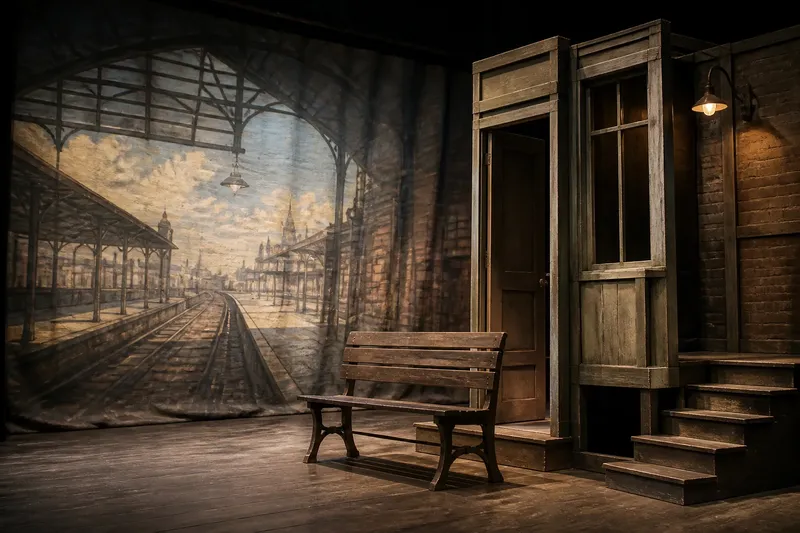
What does a stage backdrop ask you to believe: that a painted surface is a whole landscape, or that the actors occupy a place with real depth? The history of stage backdrops moves between those ideas. Painted cloth can turn a bare stage into a city street with a few lines and colours; built scenery can give a doorway, wall or stair a physical presence. Neither approach simply replaced the other. Each offers a different way to direct the audience’s attention.
Painted cloth made a room out of a flat surface
For centuries, theatres used painted flats and hanging cloths to suggest places that could not be built in full. A backdrop might show a palace garden, a distant harbour or a room whose architecture continued beyond the actors. The image supplied information quickly, while the performers and a small number of stage properties completed the illusion.
Perspective painting made a flat surface appear to recede. Lines in a floor, a row of columns or a narrowing street could draw the eye towards a distant point. The effect depended on where the audience sat and how the painted lines aligned with the stage. From a central seat, a street could seem to stretch away; from the side, the painted geometry might become more obvious.
Painted cloth also let a production shift place without rebuilding the whole stage. A scene change could involve lowering one cloth and raising another, or moving painted flats into position. The audience read the new setting through its colour, shapes and familiar visual signs: a window for a room, a horizon for open country, a columned façade for a civic building.
That speed came with a particular kind of theatrical honesty. A painted doorway did not need to open, and a painted landscape did not need to withstand a performer walking through it. The audience could accept the image as a convention, much as it accepts that a few lines of dialogue can establish a journey.
Stage backdrops changed with lighting and sightlines
Painted scenery is not just a picture; it is a surface that catches light. A wash of colour can alter the atmosphere of a cloth, while a strong sidelight can reveal brush texture or the folds in the fabric. A scenic artist may paint a shadow into a building, but stage lighting can cast another shadow across it. When those two effects disagree, the painted illusion can flatten or become confusing.
The audience’s position matters, too. A backdrop painted for a frontal view may look convincing from the stalls but less so from a side box. In a small studio, a wide cloth can dominate the room; in a larger theatre, the same image may need bold shapes and clear contrasts to remain legible at a distance.
These practical demands shaped the way artists treated detail. A close-up painting might be admired as craft, but an intricate pattern could blur into visual noise from the back of the auditorium. Strong silhouettes, clear colour areas and a readable horizon often communicate more effectively than a mass of tiny marks.
When looking at a painted setting, notice where the image wants your eye to rest. That point often reveals the intended viewing angle.
Constructed scenery gives actors a place to meet
As scenic design developed, more productions used three-dimensional elements: walls, platforms, staircases, doors and architectural fragments. These pieces do not merely depict a place. They create surfaces and routes that actors can touch, cross or occupy. A wall can divide a stage; a step can change a performer’s height; a doorway can shape an entrance before anyone appears.
Built scenery makes depth tangible, but it does not require a complete room. A production can use one freestanding wall and a window frame to suggest a house, leaving the rest of the stage open. A low platform might serve as a terrace in one scene and a raised street in another. The set’s incompleteness can be part of its meaning: the audience fills in what is absent.
There is a trade-off in what each approach lets performers do. A painted door can imply an exit without interrupting the image; a working door gives an actor a real threshold to cross, but needs space and sound consideration. A painted staircase can point towards an imagined upper floor; a built stair offers a playable route and changes how bodies move onstage.
For a simple invented situation, imagine a school hall staging a scene in a railway waiting room. The starting point is an empty platform and a limited stock of materials. The team hangs a painted cloth showing a distant station roof, then places a real bench and a narrow doorframe downstage; the expected visible result is a setting with painted distance behind the actors and a usable place for them to sit or enter.
Painted and built scenery create different kinds of distance
The central difference is not old versus new, but image versus physical invitation. A painted cloth can gather a whole world into one view. Its distant hills, windows or streets remain beyond reach, which can make a stage feel expansive even when its footprint is modest. Constructed scenery brings selected parts of that world close enough to touch, while often leaving the rest unseen.
That distinction affects how an audience reads the action. Against a painted forest, an actor may seem to stand inside an illustration. Among a few real trunks or branches, the same actor appears to negotiate a physical environment. Neither response is inherently more convincing. The choice depends on whether the production wants the setting to behave as a picture, a playable place or a deliberate mixture.
Designers often combine the two. A built window can sit in front of a painted city; a real staircase can lead towards a flat depicting an impossible upper storey. Such combinations allow one element to carry practical action and another to supply scale or atmosphere. Their success depends on making the boundary feel intentional rather than accidental.
When comparing designs, ask what the audience is being invited to imagine beyond the visible edge.
Stage backdrops still offer useful choices
Painted cloth remains useful when a production needs a clear, flexible image without filling the stage with hard scenery. It can suggest a location, establish a visual style or create a strong frame around performers. A painted surface can also be openly expressive: colours and shapes may communicate mood instead of copying a literal place.
Built scenery is useful when the action depends on contact with the environment. A performer who climbs, leans, hides or passes through a doorway may need a sturdy, real feature. Even then, the set can stay selective. One carefully placed wall can define a room more clearly than a complete arrangement of furniture and fittings.
For a school, community or small touring production, the choice often involves storage, transport and reuse as well as appearance. Cloth can be rolled or folded, while rigid scenery takes up space and needs a suitable way to move. A modular platform or a reusable frame may serve several productions, but only if its scale and finish suit the room and the story.
For any production, check the theatre’s access, rigging and fire-safety requirements alongside the materials’ labels and supplier instructions; consult the venue’s technical staff where needed.
How should you read a stage backdrop?
Why do painted backdrops use perspective?
Perspective gives a flat image the appearance of depth by making lines and forms seem to recede. Its effect depends on the audience’s viewing angle, so the painted vanishing point often works best from a particular part of the auditorium.
What is the difference between a flat and a backdrop?
A flat is a framed scenic panel, often painted to represent a wall or other vertical surface. A backdrop is commonly a large cloth hung behind the action, though productions may use the terms differently according to their equipment and practice.
Why combine a painted cloth with built scenery?
The painted image can provide distance or atmosphere, while constructed pieces give actors something practical to use. A real bench before a painted station, for instance, lets the audience see both a playable foreground and a larger imagined setting.
Does realistic scenery always feel more convincing?
No. A detailed room may suit a production that depends on domestic realism, while a painted image can feel more truthful to a story told through memory, fantasy or stylised action. Conviction comes from the design’s relationship to the performance, not from physical detail alone.
Look for the boundary between image and place
When you next watch a production, notice where the backdrop ends and the actors’ world begins. Look at whether they touch the scenery, move in front of it or seem to enter its painted depth. Those small choices reveal how the design asks you to imagine a setting. Stage backdrops remain more than decoration: they shape the distance between the audience, the performers and the world the play makes visible.